

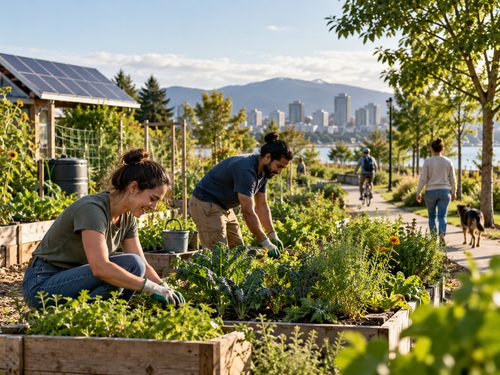
How everyday choices can help create healthier, stronger communities for future generations.
When people hear the word sustainability, they often think about solar panels, electric vehicles, or major environmental projects. While these are all part of the conversation, sustainability begins much closer to home.
It starts with the decisions we make every day: how we use energy, how much food we waste, what we throw away, and how we care for the places where we live.
Building a sustainable community doesn’t necessarily require large investments or complicated technology. Sometimes, it begins with something as simple as turning off unnecessary lights, planting a garden, repairing something instead of replacing it, or helping a neighbor understand how to reduce waste.
The important thing is recognizing that small actions, when practiced by many people, can make a meaningful difference.
What Does Sustainability Really Mean?
At its heart, sustainability means using our resources responsibly today without compromising the ability of future generations to meet their own needs.
It involves more than protecting the environment. Sustainability also includes supporting local economies, strengthening neighborhoods, and helping people develop habits that benefit both their households and their communities.
For example, a family that reduces food waste may save money on groceries. A business that improves energy efficiency may lower operating expenses. A neighborhood that plants trees may create more pleasant outdoor spaces while helping provide shade during hot weather.
These are practical examples of sustainability that can benefit people directly.
Reducing Waste Begins at Home
One of the easiest ways to practice sustainability is to look at what we throw away.
Every year, households discard food, packaging, clothing, electronics, and other materials that might have been used longer, repaired, donated, or recycled.
Reducing this waste doesn’t have to be difficult.
Families can begin by planning meals, storing food properly, reusing containers when appropriate, and donating usable items instead of throwing them away.
Communities can support these efforts through recycling education, neighborhood cleanup events, repair workshops, and programs that help residents understand how to make better use of their resources.
The goal isn’t to expect everyone to live perfectly. It’s to help people discover better choices that fit their everyday lives.
Saving Energy and Resources
Energy conservation is another area where small changes can add up.
Turning off lights when rooms are empty, using energy-efficient appliances, sealing drafts around doors and windows, and maintaining heating and cooling systems can help households reduce unnecessary energy use.
Water conservation is equally important. Fixing leaking faucets, avoiding unnecessary water use, and choosing water-efficient fixtures can help preserve resources while potentially reducing household expenses.
When businesses, schools, and households participate together, these individual efforts can have a broader community impact.
Supporting Local Communities
Sustainability also involves how we support one another.
Buying from local businesses when practical, participating in community gardens, supporting farmers’ markets, and volunteering for neighborhood improvement projects can contribute to a stronger local economy and greater community cooperation.
A sustainable community is not simply one that uses fewer resources. It is also one where people share knowledge, help solve problems, and work together to improve their surroundings.
Schools, churches, libraries, neighborhood associations, and local organizations can all play important roles by offering educational programs and encouraging residents to participate.
Education Is Where Change Begins
One of the greatest opportunities for improving sustainability is education.
Many people would like to make environmentally responsible decisions but may not know where to begin. Others believe that meaningful change requires expensive equipment or major lifestyle adjustments.
Providing practical, understandable information can help overcome those barriers.
Workshops, community newsletters, public demonstrations, school activities, and simple conversations can introduce people to ideas they can use immediately.
Children can learn why conserving water matters. Adults can discover ways to reduce household expenses. Business owners can explore methods for improving efficiency.
When people understand both the environmental and financial benefits of sustainability, they are better equipped to make informed decisions.
Education also creates opportunities for people of different generations to learn from one another.
Technology Has a Role to Play
Technology can help communities become more sustainable, but it doesn’t have to be complicated.
Modern tools can help identify wasted energy, improve resource management, monitor environmental conditions, and support more efficient operations.
For example, infrared imaging can help identify heat escaping from buildings or detect equipment problems that may lead to unnecessary energy consumption.
Other technologies can support water conservation, improve agricultural practices, and help businesses reduce waste.
However, technology works best when people understand what it does and how it can address a real problem.
Innovation should not simply be about creating something new. It should also be about finding practical ways to make life better.
Building a Better Future Together
No single person, family, business, or organization can solve every environmental challenge. But communities can make progress when people begin working toward common goals.
Imagine the difference if more households reduced unnecessary food waste, more businesses looked for ways to conserve energy, and more neighborhoods encouraged residents to participate in local improvement projects.
Not every effort will produce immediate results, and some changes will require cooperation, funding, and long term planning.
Still, progress often begins when someone asks a simple question:
What can we do differently today that might make tomorrow better?
Sustainability isn’t about doing everything at once. It’s about learning, making thoughtful decisions, and continuing to improve.
The small changes we make today can help build healthier, more resourceful, and more connected communities for the generations that follow.
About Keith Fields
Keith Fields is an entrepreneur with a longstanding interest in sustainability, practical innovation, and community education.
His interest in preserving natural resources and reducing unnecessary waste reflects a personal belief that everyday choices can help protect the environment and improve quality of life.
Keith is particularly interested in how education and accessible technologies can help individuals, families, and businesses discover more sustainable approaches to everyday challenges.
He believes that people don’t need to be experts to begin making a difference. By encouraging curiosity, sharing useful information, and helping others recognize opportunities for improvement, he hopes to contribute to a more sustainable future.
For more information or to contact Keith: https://succeedswithkeith.com/sustainability
Carol A Santella
Carol A Santella is the Founder of The Recognition Effect™ and Creator of The Mark of Distinction™. As a positioning strategist, publisher, interviewer, and recognition specialist, her work centers on discovering and honoring the character, expertise, care, innovation, and meaningful contributions that distinguish professionals and organizations. Drawing on decades of experience, Carol combines perceptive listening, thoughtful inquiry, and strategic insight to help people recognize and articulate what makes their work and contributions distinctive. Through authentic positioning, editorial storytelling, and meaningful recognition initiatives, she brings forward the people, values, and accomplishments deserving of greater recognition, creating lasting credibility, human connection, and a ripple effect that extends beyond the original recognition.